Showing posts with label Fantasy. Show all posts

21 September 2011

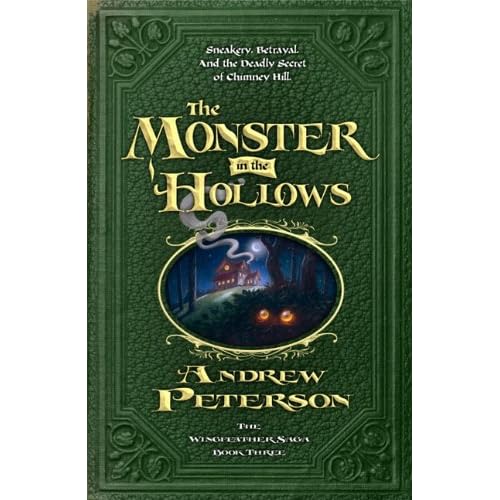
The Monster in the Hollows (Wingfeather Saga) - Andrew Peterson

"It is an ancient need to be told stories. But the story needs a great storyteller."

Purchase Here


 Book Three of The Wingfeather Saga
Janner Wingfeather's father was the High King of Anniera. But his father is gone. The kingdom has fallen. The royal family is on the run, and the Fang armies of Gnag the Nameless are close behind.
Janner and his family hope to find refuge in the last safe place in the world: the Green Hollows--a land of warriors feared even by Fangs of Dang. But there's a big problem. Janner's little brother-heir to the throne of Anniera-has grown a tail. And gray fur. Not to mention two pointed ears and long, dangerous fangs. To the suspicious folk of the Green Hollows he looks like a monster.
But Janner knows better. His brother isn't as scary as he looks. He's perfectly harmless.
Or is he?
Join the Wingfeathers on an adventure filled with mystery, betrayal, and sneakery in a land of tasty fruits. There's a monster on the loose and the truth lurks in the shadows. 

***
Andrew Peterson is a master wordsmith.  A storyteller extraordinaire.  His books make all of us that read his words better people.  He spins a yarn effortlessly, brilliantly but that is not what he does best.  What he does best is remind us that there is more to us than us.  He reminds us that our Lord and Maker is our one true gift, he never leaves or deviates from that one primary, central truth.  

Lest one think that this is simply just another Christian fantasy novel please hear me when I say that 'The Wingfeather Saga' is no more a trite trio of books than the 'The Lord of the Rings' was simply another tale of elves and wizards.  Andrew Peterson deserves his place among the great authors that came before...Tolkien, Lewis.  If you have ever lamented the fact that you were too young to have witnessed first hand the birth of a classic novel then I suggest you begin reading Andrew Peterson post haste, for here in this collected work we have true artistry, a classic tale destined to be read and reread for generations to come.  How blessed we are to have a writer like Peterson among our midst.

'The Monster in the Hollows' is a book you will want to read with your children if you have them.  If not, then it is a book that you will simply want to read.  I feel compelled to warn you before hand that once you pick up this book you will have a very hard time putting it down.  Expect long nights, missed appointments and for your answering machine to fill up.  Feed your pets ahead of time and fill your coffee cup because you are in for a fantastic journey.

***


Andrew Peterson


Hey, folks. If you're just discovering me or any of my work, it can be a little confusing because there are several facets to it. Here's the rundown:
* I write songs. I also record them to these cool things called CDs and put on concerts around the country. (And beyond! To my great delight, I get to play in Europe every year or so.)
* I write books. Right now I'm three books into a fantasy series for young readers. It's called the Wingfeather Saga. I just published book three (of four), in May of 2011. I also illustrated some of the pictures. (WingfeatherSaga.com)
* I'm the proprietor of the Rabbit Room., a community of songwriters, authors, and artists interested in storytelling, faith, and fellowship. We have a yearly conference called Hutchmoot, which is as awesome as it sounds. (Hutchmoot.com)
* I'm a proud member of the Square Peg Alliance, a happy band of singer/songwriters who write together, tour together, and eat together. (SquarePegAlliance.com)
* I've been married for fifteen years to Jamie, and we have three sweet children: Aedan (12), Asher (11), and Skye (8). We live in a magical place we call the Warren, just south of Nashville.
The common thread in all this is my love for Christ and his Kingdom, my belief in the power of story and art, and my need for family and community. If I had to boil it all down, I'd say this: I want to use my gifts to tell the truth, and to tell it as beautifully as I can.


* I received an advance copy from the publisher for purposes of review. I was in no way obligated to write a review much less a favorable one. The opinions stated herein are all my own.

08 September 2011

HOW TO KEEP YOUR VOLKSWAGEN ALIVE A NOVEL CHRISTOPHER BOUCHER


9781935554639
EBOOK: 9781612190068

It's hard being a single dad—especially when your son is a 1971 Volkswagen Beetle. 

There’s nothing more troubling than having your child break down on the side of the road, leaking oil, overheating, and asking tough questions like, “What is death?” and “Why did Mom leave?”
But stay calm!
Because How To Keep Your Volkswagen Alive is not only a dizzyingly beautiful novel, it’s also a handy manual with useful chapters on “Tools and Spare Parts,” “Valve Adjustment,” “How To Read This Novel,” and, most important of all, “How Works a Heart.”
Welcome to Christopher Boucher’s zany literary universe, a place where metaphors shift beneath your feet, familiar words assume new meanings, objects talk, trees attack, and time actually is money. Modeled on the cult classic 1969 hippie handbook of the same name, How To Keep Your Volkswagen Alive is an astonishing tour-de-force that tackles some of life’s biggest questions: How do you cope with losing a parent? What’s the secret to raising a child? How do you keep love alive? How do you get your car to start?

***
This is a tale about a man, his father and the man's son.  That is almost all I can say.  Boucher is a wordsmith extraordinaire.  He uses symbolism and metaphor like most people use their cell phones.  I'm equally torn between absolutely loving this book and being totally frustrated by it.  While I find creative use of language fascinating and engaging, in this instance it made me feel like I didn't totally "get" everything that was happening. I played along for most of the book because it is a very well written novel with an unusual take on storytelling and I love when authors push the limits of their craft.  I particularly love when authors take the craft of writing into the realm of creative art. However, I felt abandoned as a reader by Boucher as he seemed more concerned with obscuring reality than letting the reader actually understand what was going on.  Instead of breathing life into the emotional aspects of the story the author chose to hide that emotion amidst symbology, representation and shifting words in odd ways. Boucher nearly had me singing his praises ardently, he nearly had me swooning with adoration.  As it stands now Boucher will be an author to keep a keen eye on. 
"Yes, I think it was, because it was the same day that I bought the corpse of an old accordian who'd gotten in a bar fight and been stabbed and killed. I bought it from a moustached truck who was selling it for two and a half hours."
***


ABOUT THE AUTHOR
CHRISTOPHER BOUCHER received his MFA in Fiction from Syracuse University, where he studied with George Saunders and Junot Díaz. Before moving to Syracuse, he worked as the Arts and Entertainment Writer for The Daily Hampshire Gazette, and drove (when it started) a 1971 Volkswagen Beetle. He currently teaches writing and literature at Boston College, and is the managing editor of Post Road Magazine. In his free time, he plays banjo in a bluegrass band.


* I received an advance copy from the publisher for purposes of review. I was in no way obligated to write a review much less a favorable one. The opinions stated herein are all my own.

03 August 2011

Haroun and the Sea of Stories by Salman Rushdie


Set in an exotic Eastern landscape peopled by magicians and fantastic talking animals, Salman Rushdie’s classic children’s novel Haroun and the Sea of Stories inhabits the same imaginative space as Gulliver’s Travels, Alice in Wonderland, and The Wizard of Oz. In this captivating novel, Haroun, a 12-year-old boy sets out on an adventure to restore the poisoned source of the sea of stories. On the way, he encounters many foes, all intent on draining the sea of all its storytelling powers.
***

You may have heard about Salman Rushdie.  You might indeed know of his controversial flight for his safety and the famous million dollar price tag for his life.  Some of you may even have notions of his goodness or lack thereof.  It would, in my humble opinion, be doing yourself a favor of the highest order to reconsider.  Set aside those ideas you may have of the man himself, dip your toes into Rushdie's magical sea and just allow yourself to be transported nimbly into another place and time.  A mythical, magical, fanciful tale woven out of a brilliant imagination and crafted from the finest language.  It is simply a delight and coincidentally one of my most favored books.
***
So Iff the water genie told Haroun about the Ocean of the Stream of Stories, and even though he was full of a sense of hopelessness and failure the magic of the Ocean began to have an effect on Haroun. He looked into the water and saw that it was made up of a thousand thousand thousand and one different currents, each one a different colour, weaving in and out of one another like a liquid tapestry of breathtaking complexity; and Iff explained that these were the Streams of Story, that each coloured strand represented and contained a single tale. Different parts of the Ocean contained different sorts of stories, and as all the stories that had ever been told and many that were still in the process of being invented could be found here, the Ocean of the Streams of Story was in fact the biggest library in the universe. And because the stories were held here in fluid form, they retained the ability to change, to become new versions of themselves, to join up with other stories and so become yet other stories; so that unlike a library of books, the Ocean of the Streams of Story was much more than a storeroom of yarns. It was not dead, but alive.
"And if you are very, very careful, or very, very highly skilled, you can dip a cup into the Ocean," Iff told Haroun, "like so," and here he produced a little golden cup from another of his waistcoat pockets, "and you can fill it with water from a single, pure Stream of Story, like so," as he did precisely that.


Salman Rushdie is the author of ten novels: Grimus, Midnight’s Children (which was awarded the Booker Prize in 1981), Shame, The Satanic Verses, Haroun and the Sea of Stories, The Moor’s Last Sigh, The Ground Beneath Her Feet, Fury,Shalimar the Clown and The Enchantress of Florence.
He is also the author of a book of stories, East, West, and three works of non-fiction – Imaginary Homelands, The Jaguar Smile, and Step Across This Line. He is the co-editor of Mirrorwork, an anthology of contemporary Indian writing, and of the 2008 Best American Short Stories anthology.
He has adapted Midnight’s Children for the stage. It was performed in London and New York by the Royal Shakespeare Company. In 2004, an opera based upon Haroun and the Sea of Stories was premiered by the New York City Opera at Lincoln Center.
A Fellow of the British Royal Society of Literature, Salman Rushdie has received, among other honours, the Whitbread Prize for Best Novel (twice), the Writers’ Guild Award, the James Tait Black Prize, the European Union’s Aristeion Prize for Literature, Author of the Year Prizes in both Britain and Germany, the French Prix du Meilleur Livre Étranger, the Budapest Grand Prize for Literature, the Premio Grinzane Cavour in Italy, the Crossword Book Award in India, the Austrian State Prize for European Literature, the London International Writers’ Award, and the James Joyce award of University College Dublin.
He holds honorary doctorates and fellowships at six European and six American universities, is an Honorary Professor in the Humanities at M.I.T, and Distinguished Writer in Residence at Emory University. He has received the Freedom of the City in Mexico City, Strasbourg and El Paso, and the Edgerton Prize of the American Civil Liberties Union. He holds the rank of Commander in the Order of Arts and Letters – France’s highest artistic honour.
Between 2004 and 2006 he served as President of PEN American Center, and continues to work as President of the PEN World Voices International Literary Festival, which he helped to create. In June 2007 he received a Knighthood in the Queen’s Birthday Honours. In 2008 he became a member of the American Academy of Arts and Letters and was named a Library Lion of the New York Public Library. In addition, Midnight’s Children was named the Best of the Booker – the best winner in the award’s 40 year history – by a public vote.
His books have been translated into over forty languages. Films are currently in production of bothMidnight’s Children and Haroun and he Sea of Stories. 


02 August 2011

The Miraculous Journey of Edward Tulane A novel by Kate DiCamillo


Candlewick Press, 2006
Ages 7 and up, ISBN 0-7636-2589-2

Once, in a house on Egypt Street, there lived a china rabbit named Edward Tulane. The rabbit was very pleased with himself, and for good reason: he was owned by a girl named Abilene, who treated him with the utmost care and adored him completely.

And then, one day, he was lost.


Kate DiCamillo and Bagram Ibatoulline take us on an extraordinary journey, from the depths of the ocean to the net of a fisherman, from the top of a garbage heap to the fireside of a hoboes' camp, from the bedside of an ailing child to the streets of Memphis. And along the way, we are shown a true miracle — that even a heart of the most breakable kind can learn to love, to lose, and to love again.


***

This is an absolutely beautiful tale.  It will break your heart, warm your soul and make you smile.  Words really can't express how much I love this book.  It will always hold a place of honor on our bookshelf.  If you have even the smallest glimmer of sentimentality in your heat, have a fondness for The Velveteen Rabbit, have a penchant for love stories (for this is truly a love story...), or just simply enjoy reading an amazingly well crafted story deftly told by an able artist then please consider gifting yourself with the joy that is Edward Tulane.
***

Chapter One
 
Once, in a house on Egypt Street, there lived a rabbit who was made almost entirely of china. He had china arms and china legs, china paws and a china head, a china torso and a china nose. His arms and legs were jointed and joined by wire so that his china elbows and china knees could be bent, giving him much freedom of movement.
    His ears were made of real rabbit fur, and beneath the fur, there were strong, bendable wires, which allowed the ears to be arranged into poses that reflected the rabbit’s mood — jaunty, tired, full of ennui. His tail, too, was made of real rabbit fur and was fluffy and soft and well shaped.
    The rabbit’s name was Edward Tulane, and he was tall. He measured almost three feet from the tip of his ears to the tip of his feet; his eyes were painted a penetrating and intelligent blue.
    In all, Edward Tulane felt himself to be an exceptional specimen. Only his whiskers gave him pause. They were long and elegant (as they should be), but they were of uncertain origin. Edward felt quite strongly that they were not the whiskers of a rabbit. Whom the whiskers had belonged to initially — what unsavory animal — was a question that Edward could not bear to consider for too long. And so he did not. He preferred, as a rule, not to think unpleasant thoughts.
    Edward’s mistress was a ten-year-old, dark-haired girl named Abilene Tulane, who thought almost as highly of Edward as Edward thought of himself. Each morning after she dressed herself for school, Abilene dressed Edward.
    The china rabbit was in possession of an extraordinary wardrobe composed of handmade silk suits, custom shoes fashioned from the finest leather and designed specifically for his rabbit feet, and a wide array of hats equipped with holes so that they could easily fit over Edward’s large and expressive ears. Each pair of well-cut pants had a small pocket for Edward’s gold pocket watch. Abilene wound this watch for him each morning.
    “Now, Edward,” she said to him after she was done winding the watch, “when the big hand is on the twelve and the little hand is on the three, I will come home to you.”
    She placed Edward on a chair in the dining room and positioned the chair so that Edward was looking out the window and could see the path that led up to the Tulane front door. Abilene balanced the watch on his left leg. She kissed the tips of his ears, and then she left and Edward spent the day staring out at Egypt Street, listening to the tick of his watch and waiting.
     Of all the seasons of the year, the rabbit most preferred winter, for the sun set early then and the dining-room windows became dark and Edward could see his own reflection in the glass. And what a reflection it was! What an elegant figure he cut! Edward never ceased to be amazed at his own fineness.
    In the evening, Edward sat at the dining-room table with the other members of the Tulane family: Abilene; her mother and father; and Abilene’s grandmother, who was called Pellegrina. True, Edward’s ears barely cleared the tabletop, and true also, he spent the duration of the meal staring straight ahead at nothing but the bright and blinding white of the tablecloth. But he was there, a rabbit at the table.
    Abilene’s parents found it charming that Abilene considered Edward real, and that she sometimes requested that a phrase or story be repeated because Edward had not heard it.
    “Papa,” Abilene would say, “I’m afraid that Edward didn’t catch that last bit.”
    Abilene’s father would then turn in the direction of Edward’s ears and speak slowly, repeating what he had just said for the benefit of the china rabbit. Edward pretended, out of courtesy to Abilene, to listen. But, in truth, he was not very interested in what people had to say. And also, he did not care for Abilene’s parents and their condescending manner toward him. All adults, in fact, condescended to him.
    Only Abilene’s grandmother spoke to him as Abilene did, as one equal to another. Pellegrina was very old. She had a large, sharp nose and bright, black eyes that shone like dark stars. It was Pellegrina who was responsible for Edward’s existence. It was she who had commissioned his making, she who had ordered his silk suits and his pocket watch, his jaunty hats and his bendable ears, his fine leather shoes and his jointed arms and legs, all from a master craftsman in her native France. It was Pellegrina who had given him as a gift to Abilene on her seventh birthday.
    And it was Pellegrina who came each night to tuck Abilene into her bed and Edward into his.
    “Will you tell us a story, Pellegrina?” Abilene asked her grandmother each night.
    “Not tonight, lady,” said Pellegrina.
    “When?” asked Abilene. “What night?”
    “Soon,” said Pellegrina. “Soon there will be a story.”
    And then she turned off the light, and Edward and Abilene lay in the dark of the bedroom.
    “I love you, Edward,” Abilene said each night after Pellegrina had left. She said those words and then she waited, almost as if she expected Edward to say something in return.
    Edward said nothing. He said nothing because, of course, he could not speak. He lay in his small bed next to Abilene’s large one. He stared up at the ceiling and listened to the sound of her breath entering and leaving her body, knowing that soon she would be asleep. Because Edward’s eyes were painted on and he could not close them, he was always awake.
    Sometimes, if Abilene put him into his bed on his side instead of on his back, he could see through the cracks in the curtains and out into the dark night. On clear nights, the stars shone, and their pinprick light comforted Edward in a way that he could not quite understand. Often, he stared at the stars all night until the dark finally gave way to dawn.


THE MIRACULOUS JOURNEY OF EDWARD TULANE by Kate DiCamillo. Text copyright © 2006 by Kate DiCamillo. Illustrations copyright © 2006 by Bagram Ibatoulline. Published by Candlewick Press, Inc., Cambridge, MA.


ABOUT THE AUTHOR


I was born in Philadelphia, Pennsylvania, raised in Clermont, Florida, and currently live in Minneapolis, Minnesota. I write for both children and adults and I like to think of myself as a storyteller.
Here are a few more facts about me: I am short. And loud. I hate to cook and love to eat. I am single and childless, but I have lots of friends and I am an aunt to three lovely children (Luke, Roxanne, and Max) and one not so lovely dog (Henry).
I think of myself as an enormously lucky person: I get to tell stories for a living.